


Pennsylvania did not split over a sandwich by accident.
It was built that way.
In 1901, the U.S. government opened the Hog Island shipyard in South Philadelphia. It was not romantic work. It was loud, urgent, industrial. Steel hulls rising from mud. Warships shaped by hands that smelled of iron and salt. The country needed vessels. It needed speed. It needed labor.
Italian immigrants answered.
They came with skill and hunger. They came with recipes folded into memory. At noon, they unwrapped long, seeded rolls stuffed with cured meats, sharp provolone, and whatever could stretch far enough to feed a crew. The sandwich was practical—dense, filling, built for men who worked with their backs and shoulders.
Locals called it the Hog Island sandwich.
Names, like bread, tend to compress over time. By the 1920s, Hog Island softened into something quicker on the tongue.
Hoagie.
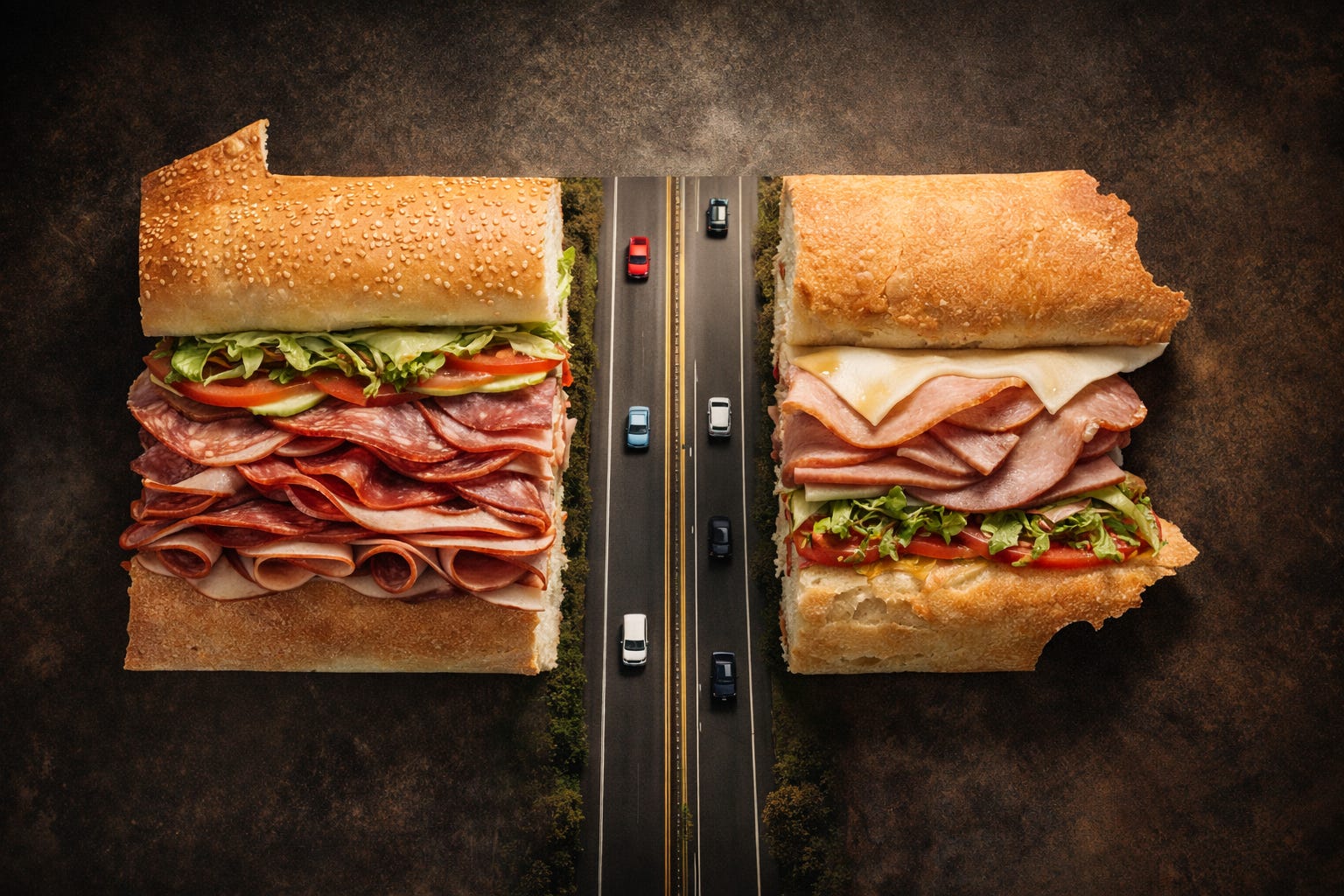
The word stuck because the work stuck. It carried the weight of labor and belonging. It wasn’t just food; it was evidence. Evidence that a community had arrived and carved out space with its own flavor.
Then came the war again.
World War II turned Hog Island into a machine. Ships launched into the Atlantic. Men left. Some returned. Afterward, the country did what it always does after survival—it built outward.
Highways unfurled across the state.
The Pennsylvania Turnpike expanded west in the 1940s and 1950s. Concrete cut through hills. Asphalt connected steel towns to farm country, cities to suburbs. Roads do more than move cars. They move language. They move habits. They move allegiance.
As the Turnpike stretched, something subtle happened.
Western Pennsylvania leaned toward the Midwest. Trade patterns shifted. Cultural gravity pulled differently. “Sub.” “Grinder.” Words that traveled along different commercial routes took root in Pittsburgh and beyond.
Philadelphia did not bend.
It doubled down.
In South Philly, bakeries like Sarcone’s kept baking long, seeded rolls every day. Oil and vinegar only. The layering mattered. Meat folded, not stacked. The bread had bite. The proportions were inherited, not negotiated.
It was not nostalgia. It was continuity.
Meanwhile, western delis leaned heavier. Thicker bread. Different cuts. Mayo where there had been oil. The sandwich was still generous, still honest—but it was not a hoagie.
This was not an argument about ingredients.
It was infrastructure hardening identity.
When roads separate communities long enough, speech follows. When supply chains shift, so does vocabulary. A word becomes shorthand for where you’re from, who you stand with, what history you claim.
By the 1990s, the divide was clear. Walk into a Philadelphia shop and ask for a sub, and someone might smile politely before correcting you. Walk into a western Pennsylvania deli and order a hoagie, and you might get a raised eyebrow.
The correction is not about arrogance.
It is about preservation.
Because what survived in that word survived a century of upheaval. War. Industrial collapse. Suburban sprawl. Corporate standardization that tried to flatten flavor into something printable and identical coast to coast.
“Hoagie” endured because a community decided it would.
Language follows the road, yes. But it also resists it.
There is something deeply human in protecting small distinctions. We live in an age that compresses everything—culture, speech, taste—into marketable sameness. Chain restaurants replace corner shops. Uniformity replaces texture.
Yet here is Pennsylvania, quietly split not by ideology but by bread.
It tells us something.
Identity is not always declared in speeches. Sometimes it is declared at a counter. It is declared in how oil is poured, in whether the roll is seeded, in whether you say hoagie or sub.
The highways were engineered. The shipyard was engineered. The economic shifts were engineered.
But the loyalty? That was chosen.
Communities decide what they will carry forward.
When someone corrects you—“It’s a hoagie”—they are not only fixing your vocabulary. They are guarding a lineage. They are defending the memory of immigrant laborers who fed crews with long rolls meant to sustain strength. They are resisting the idea that all sandwiches are interchangeable.
They are saying: this survived.
It survived world wars. It survived migration patterns. It survived corporations that wanted uniform menus. It survived the slow erosion of local distinctiveness.
And so the word matters.
Food often becomes the soft place where hard history rests. It is easier to argue about bread than about belonging. But beneath the argument is a philosophical truth: infrastructure shapes culture, but culture pushes back.
The road can split a state. It cannot erase its stories.
Pennsylvania did not fracture over preference. It evolved along its highways. Language followed commerce. Commerce followed concrete. But memory stayed local.
In the east, the hoagie remains layered with oil and vinegar, built on a seeded roll baked daily. In the west, the sub leans heartier, shaped by different trade routes and tastes.
Neither is wrong.
Both are maps.
Ask someone what they call it, and you will learn more than their lunch order. You will learn where their grandparents settled. Which highways shaped their childhood. Which corner shops fed them after Little League games. Which bakeries perfumed their mornings.
So what do you call it?
That depends on which road you grew up near.
But whatever you say, know this: you are speaking history.
Your Fellow Writer,
Rinaldo
Thank you for reading. This work is reader-supported, and your presence here matters.

About the Author
John Rinaldo writes Soul & Stories, a weekly publication centered on soul work, reflection, and the quiet process of becoming. He also hosts the live podcast Stories, Soul Work & Substack every Monday at 4 PM EST, where written ideas open into honest conversation.
He is currently working on The Hole: Forgotten in the Shadows, a documentary written and hosted by John Rinaldo and Hassan, telling the story of Italians who resisted and secretly helped smuggle Jews to safety during World War II.

© 2026 John V. Rinaldo. All rights reserved.
This work is protected under U.S. and international copyright law. No part of this publication may be reproduced, distributed, displayed, or transmitted in any form without prior written permission. Official publications are released only through verified accounts directly controlled by John V. Rinaldo.
Great historical and insightful .. as I read each line family heritage was most apparent.
When people share their thoughts in a world that screams " look this way, believe what I tell you" stories like this remind us what we hold most dear. Thank you and many blessings.
What an interesting piece of history and that it was bread not pasta (don't Italians and pasta go together?) that takes centre stage. Come to think of it, cold pizza could have been the meal choice, but bread was chosen. I guess a sandwich is the most practical of choices.