



It began with a simple post. A memory wrapped in tights and yeast spread, in teddy bears and afternoon rests. Zuzana wrote of her childhood in Czechoslovakia—black humor, scarcity, small rebellions under the weight of a regime. Her words carried the rhythm of childhood indignities but also the stubbornness of spirit: the sly smile of her mother, the refusal to surrender wonder even in the grayest times.
Reading her stories, I felt the echo of my own. And suddenly, I was back in West Germany. November 9th, 1989.
That morning began with confusion. My cousin burst into my room shouting, “Communism no more!” I had been half-asleep, tangled in blankets, too young to understand, and too restless to think deeply. His words landed like thunder but also like a joke.
Outside, the streets stirred with something unfamiliar. A vibration. Not quite joy, not yet chaos. Just movement. The television hummed with the same message: the Berlin Wall was open.
We were foolish and young, so we ran to the train. The ride was filled with strangers, their faces taut, expectant, and tired from years of waiting. We wanted to see history. What we didn’t expect was to feel the weight of lives divided for so long.
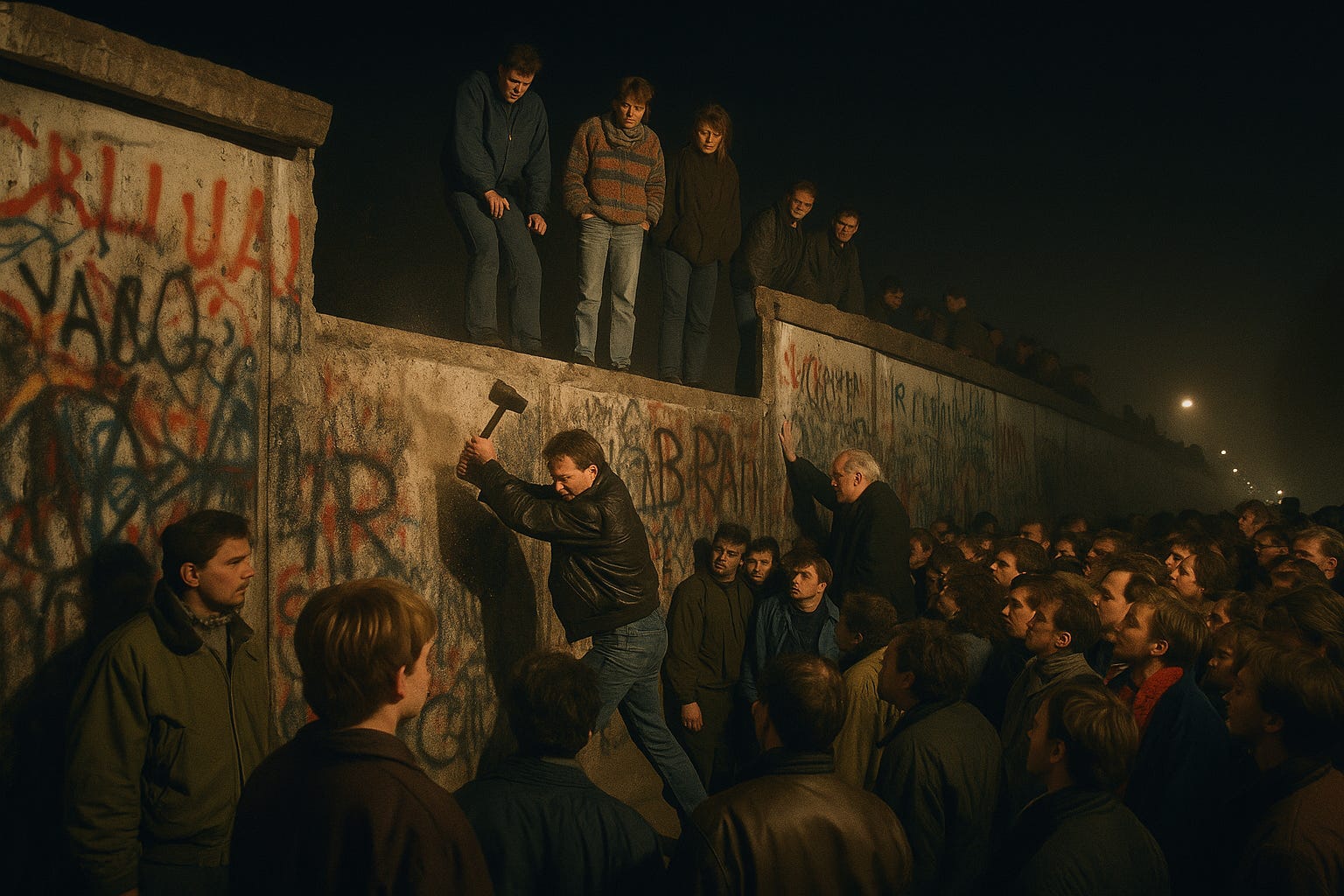
The Wall itself looked less like a monument and more like a scar. Painted, cracked, covered in slogans, and chipped away by hands desperate to hold proof of freedom.
Crowds pressed together, pushing, cheering, weeping. The air was cold but electric. The West Germans sang and drank. The East Germans wandered as if sleepwalking. Their clothes were worn. Their eyes are hollow. Some laughed, but many stood bewildered, staring at shop windows filled with goods they had never touched.
I remember one old woman screaming at people to get back inside or they’d be shot. Her voice carried decades of obedience and fear. She had lived so long under threat that even freedom felt like a trap.
It was a day of celebration, yes. But it was also a day of mourning—for the years stolen, the souls starved, and the dignity stripped by hate.
The Cold War was declared over that night. We cheered it. Believed it. But wars don’t end with declarations; they shift their shape.
Soon after, the Yugoslav Civil War began. I was in Northern Italy when the refugees came. Families in broken cars, clutching plastic bags as if they were lifelines. Children too tired to cry. They wanted to be saved by people who sometimes wanted them dead.
We crossed toward the border once, against our better judgment. What I saw there haunts me still. Bodies. Blood. The absence of mercy. If East Berlin had shown me the death of souls, Yugoslavia showed me the death of bodies.
Above it all, the sound of fighter jets. Day and night, cutting across the Italian sky. To Iraq. To Croatia. To somewhere else entirely. It didn’t matter. Each sound carried the echo of bombs falling.
And I realized: the Cold War had not ended. It had only accelerated, split into smaller wars, carried forward by the same hands, the same lies.
📚 All of my stories began on Substack. Now, The Quiet Miracle and Earned, Not Given are here — new releases, available now on Amazon. ✨


What strikes me now, years later, is not only the battles but the small things that carried us through them.
Zuzana’s mother dyed tights red in a pot of boiling water, turning drab into defiance. She sewed when stores were empty. She created miracles out of scarcity.
My memories are filled with the same quiet acts. A piece of chocolate shared with a stranger. A child clutching a single toy through the chaos. A cousin shaking me awake with news that the world had shifted.
It is in these moments that history is lived—not in the speeches, not in the treaties, but in the smell of yeast spread that children hated, in the red tights a girl wore like a crown, in the look of bewilderment on a man’s face as he crossed a border that had divided him from his own kin.
Zuzana wrote of “Aunties”—teachers who screamed at children for sniffing without a handkerchief, who forced bread and milk skins on them, who demanded sleep when none was needed. Small tyrants enforcing big lies.
I saw the same faces on the streets of East Berlin. Authority not as leadership, but as domination. Orders barked because orders had always been barked.
And yet—there were always rebellions. A slice of bread stuck beneath a table. A girl peeking through half-closed lashes. A boy punching a teddy bear only for his sister to love it more fiercely.
I think now that every revolution is born in these small rebellions. Before walls fall, before regimes collapse, there is always a child somewhere refusing to eat the yeast spread.
The Cold War taught us something dangerous: that freedom could be declared like a holiday. November 9th was celebrated as a triumph, and in many ways it was. Families reunited. Borders opened. Hope returned.
But freedom is never permanent. It is not a date on a calendar. It is a value, fragile and easily traded away for comfort, for safety, for illusions.
When I looked at those East Germans, free at last, many did not know what to do with it. They had been told how to live for so long that liberty felt like a void.
And isn’t that the danger still? That we accept new forms of control disguised as protection, that we fall asleep while history repeats itself in different uniforms?
Her stories remind me of this. They strip away the grand speeches and return us to the raw truth of life under totalitarianism: tights that sag, bread that smells of socks, naps enforced by screaming women, hope carried in a goat that was supposed to be a bear.
Through the child’s eye, we see it clearly. Authority is absurd. Scarcity is comical and cruel. Rebellion is small, but real.
Her words pulled me back to that day in 1989 when the world told itself war was over, but my eyes saw otherwise. Her humor and honesty forced me to reckon again with my own memories—the faces, the jets, the hollowness of victory.
I carry the memory of the Wall coming down. I carry the faces of the East Germans wandering aimlessly in the streets of West Berlin. I carry the old woman screaming warnings from a past that would not let her go. I carry the refugees from Yugoslavia, the jets in the Italian sky, the fear that the world would always find a new battlefield.
And I carry the smaller things: my cousin’s shout, a mother’s sly smile, a child’s secret rebellion.
We must name things as they are. Wars do not end; they mutate. Authoritarians do not vanish; they change uniforms. Lies do not disappear; they are repackaged. Because there is a rhythm to memory, a cadence that carries both beauty and sorrow. We look back not only to mourn but to feel alive again. And the truth must be spoken plainly. The wall fell. But the Cold War did not end. It moved to Iraq. To the Balkans. To new fields and skies. And even now, it lingers.
Do we learn? I am not sure. Perhaps all we can do is remember, tell, and resist the small lies before they grow.
The night of November 9th, 1989, I stood in a crowd as people chipped away at the Wall. I held a piece of it in my hand, small and jagged. The air smelled of beer, sweat, stone dust, and something else—possibility.
A man from the East walked past me. He had no bag, no coat, just a stunned look. He stopped in front of a shop window filled with fruit, toys, and clothes. His hand pressed against the glass as if to make sure it was real.
That image has never left me. More than speeches, more than history books, more than the endless talk of victory. That hand on the glass. That disbelief at the sight of ordinary things.
And I think of Zuzana’s bear, her tights, her yeast bread, her naps. I think of how we survive through humor, how we rebel in small ways, how we endure through diligence and sacrifice.
The Cold War did not end on November 9th. But perhaps, in the smell of linden blossoms, in the laugh of a child, in the sly smile of a mother, freedom still lives. Fragile.
Enduring.
Always waiting to be claimed again.
- Rinaldo
Enjoyed this? Fuel me ☕……………
What began as daily reflections on Substack has grown into full books. You can now find them on Amazon, Remi’s Journey, Rediscovering Vancouver, and Dancing Letters.
Inspiration for This Story.
This story was born from a single post by Zuzana Zejdova. Her childhood memories of tights, yeast spread, teddy bears, and forced naps carried the humor and absurdity of life under totalitarian rule. Reading them pulled me back to West Germany on November 9, 1989, when my cousin burst in shouting, “Communism no more!” I rushed to see the Berlin Wall fall, only to witness both joy and hollow bewilderment. Soon after came the Yugoslav Civil War and jets overhead, reminding me that the Cold War never truly ended. Her words opened the door; my memories walked through.
—John Rinaldo
Subscribe to The Positive Pen on Substack for daily reflections and uplifting tales that brighten your week.

 | A guest post by
|