


It started with a question.
A small one, the kind that doesn’t sound like much when it leaves a child’s mouth.
My daughter was five. We were sitting by the window, snow falling in slow, quiet circles outside. It was December. She had been learning about Christmas at school — the manger, the wise men, the star that guided them — and she turned to me with eyes too big for her face and asked,
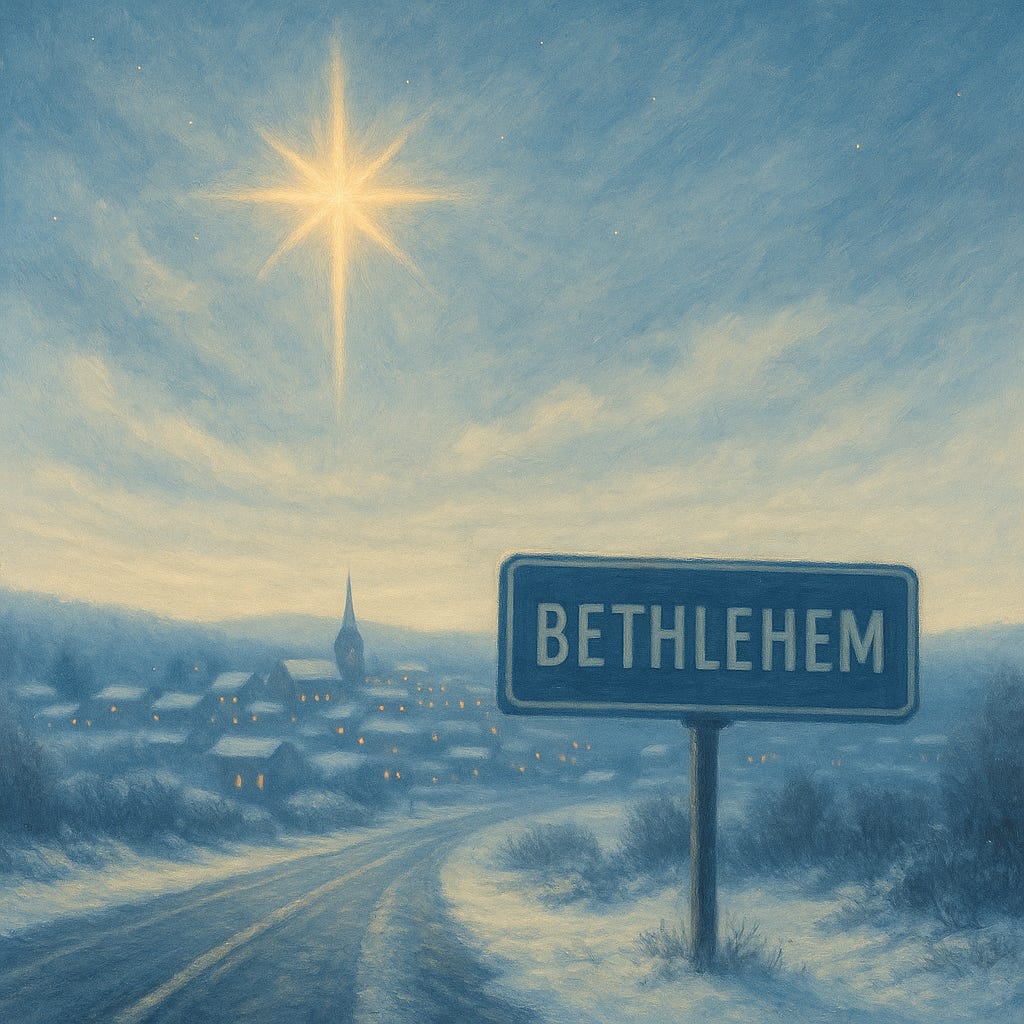
“Daddy, was Jesus born in Bethlehem, Pennsylvania?”
I remember laughing softly at first. I told her, “No, sweetheart, not this Bethlehem.” But then she tilted her head and said, “Well, maybe He could have been.”
That stayed with me.
It wasn’t the question itself — it was the way she said could have been. There was no doubt in her tone, just possibility. The way children see the world before we teach them to narrow it down.
That night I couldn’t sleep. I kept thinking about her question — not as a theologian or historian, but as a father. What if the miracle happened again, but here? In our time. Among us.
Would we even notice?
Would we recognize the sacred if it showed up in line at Wawa, or waiting for the 6 a.m. bus in the cold? Would we stop long enough to listen to an angel, or would we scroll past it on our phones?
That’s how The Quiet Miracle was born.
It didn’t come from theology or scholarship. It came from that moment — a child’s simple question, and a father’s inability to let it go.
The first version of this story came out last year. I posted it on Substack like I do with most of my writing — raw, unpolished, full of heart but missing something I couldn’t name. I didn’t like it.
It wasn’t honest enough. Not in the way I wanted. It leaned too much on the idea and not enough on the feeling.
I set it aside and went back to editing Earned, Not Given, my book about perseverance and purpose. But as I worked through those pages — writing about struggle, faith, and the long road between failure and redemption — I kept circling back to that question again:
“Was Jesus born in Bethlehem, Pennsylvania?”
And I realized something.
Maybe I wasn’t supposed to retell the Christmas story. Maybe I was supposed to recreate it.
Not in ancient Judea, but here — in the quiet streets and small towns of Pennsylvania. Not with shepherds and kings, but with ordinary people trying to make sense of their own lives. A mother who believes. A father who doubts but stays. A child who reminds us what love looks like when it’s not dressed in perfection.
I wanted to write something modern — not because I wanted to rewrite scripture, but because I wanted people to feel it again. To feel the awe of it. The simplicity. The humanity.
That’s what this story became.
It’s been more than fifteen years since that question. My daughter’s older now. The magic of those early years has turned into something quieter — respect, understanding, a shared memory of a time when belief came easy.
But this story — The Quiet Miracle — is my way of keeping that moment alive. It’s a reminder that miracles don’t only belong to the past. They can live right here, in the towns we drive through and never really see.
The Bethlehem in my story is not ancient. It’s a real place. The kind of town that looks ordinary until you start paying attention. Old brick buildings, corner diners, church bells that still ring on Sundays. A mix of old money and no money. Faith and fatigue.
It’s the kind of place where a miracle could happen quietly, without anyone noticing — and maybe that’s the point.
Because not all miracles are loud. Some slip in through the cracks. Some happen while the rest of the world looks the other way.
Every story I’ve written starts on Substack. It’s where I test the rhythm, the honesty, the pulse. It’s where readers become companions in the process — shaping, questioning, encouraging.
The Quiet Miracle began there too. But what started as a single post became something much larger — an eight-part series that grew out of faith, persistence, and a father’s promise to his daughter.
The draft on Substack is the foundation. The book version — the one you’re holding or about to read — goes deeper. It includes the parts I left unsaid. The silences between the lines. It also carries a workbook — not in the traditional sense, but as a reflection guide. Because this isn’t just a story to read; it’s one to walk through.
I believe stories should do more than entertain. They should move you — not with noise or spectacle, but with truth.
And the truth here is simple: we still need miracles.
Maybe not the kind with trumpets and halos. But the kind that shows up when we finally stop running from ourselves. The kind that reminds us that love, forgiveness, and grace are not ancient relics — they’re alive, waiting for us to notice.
“Daddy, was Jesus born in Bethlehem?”
“Yes.”
“Wow… so Jesus was born in Pennsylvania?”
That innocent moment inspired my new book, The Quiet Miracle — a modern Nativity set in Bethlehem, PA with a reflection workbook for families.

📖 Available now on Amazon → https://a.co/d/bSzaxhX
This series — eight parts in total — begins tomorrow, December 18th. Each day brings a new chapter, a new glimpse into a modern Bethlehem and the people within it.
You’ll meet Maria, a young mother caught between faith and fear.
You’ll meet Joseph, a quiet man who builds for others but never for himself.
You’ll see how small acts — a warm meal, a stranger’s kindness, a prayer whispered through exhaustion — become the threads of something divine.
It’s not a story about religion. It’s a story about humanity. About how light finds its way into the cracks of ordinary life.
I wrote it the way I try to live — simple, honest, unadorned. No grand speeches. No polished miracles. Just people trying their best.
That’s the world I believe Jesus would have entered if He were born today.
When I look back now, I realize my daughter’s question wasn’t really about geography. She wasn’t asking where Jesus was born. She was asking if miracles still happen — if something sacred could exist in our world of strip malls and deadlines, of noise and doubt.
And the answer, after all these years, is yes.
Miracles happen in quiet ways. They happen when a father listens. When a mother believes. When a child asks a question that stops time.
They happen when we forgive. When we start again. When we see someone hurting and decide not to look away.
They happen right here — in Bethlehem, Pennsylvania, and every place like it.
This isn’t just the start of one book. It’s the beginning of four.
The Quiet Miracle is the first — the birth of something sacred in a modern world.
Then comes The Carpenter’s Son — the story of growing up under the weight of expectation.
After that, The Road to Nazareth — the journey through doubt, loss, and purpose.
And finally, The Last Supper at Liberty Street — where the story meets its quiet end, not in spectacle, but in love remembered.
Each book stands alone, but together they form a tapestry — a reimagining of faith not as doctrine, but as experience.
The goal is not to change what people believe, but to remind them why they believe at all.
Writing this has taken years. It’s not the kind of project you rush.
Fifteen years from a child’s question to a finished story.
A lifetime of learning what it means to hold on to wonder.
There were times I wanted to abandon it. Times when the words felt too heavy or too holy to touch. But then I’d think about her — that little girl in her pajamas, looking up at me with snowlight in her eyes, asking if miracles could happen here.
And I knew I had to finish it.
Because maybe that’s what faith really is — not knowing for sure, but showing up anyway.
When you read The Quiet Miracle, I hope you feel something familiar.
Not nostalgia — something deeper. A stirring.
The kind that makes you look out the window a little longer. The kind that makes you want to call someone you’ve been meaning to forgive.
Because in the end, that’s what this story is about: the possibility of goodness, reborn in ordinary lives.
We don’t have to travel far to find it.
It’s already here.
Sometimes all it takes is a question from a child — and the courage to answer it with your life.
So this is how it began.
With snow falling on a quiet December night.
A daughter asking a question that changed everything.
And a father, fifteen years later, still trying to find the words that live up to it.
This is The Quiet Miracle.
A story born in Bethlehem — Pennsylvania this time.
And maybe, if we’re paying attention, in each of us too.
Enjoyed this? Fuel me ☕……..
Subscribe to The Positive Pen on Substack for honest daily reflections and uplifting stories to carry you through the week. This post is public—feel free to restack and share it with anyone who could use a little light today.

Inspiration for This Story.
In a small Pennsylvania town, a young woman receives news no doctor can explain: she is pregnant, though every test and every truth says it’s impossible. Her life and the lives around her begin to shift under the weight of this mystery.
Told through quiet moments—an unexpected diagnosis, the doubts of a working man, the long drive through winter roads, and the search for shelter on a crowded night—this story follows ordinary people caught in the pull of something extraordinary.
It is not about prophecy or doctrine. It is about resilience, trust, and the quiet strength that carries us through the unexplainable. A story of a miracle, left for the reader to decide what it means.
—John V. Rinaldo
Discover the heartfelt stories of John Rinaldo—author of Remi’s Journey, Rediscovering Vancouver, and Dancing Letters. Each book inspires hope, healing, and wonder. Available now on Amazon.

Thanks for sharing. I love moments when our children give us pause on seemingly small things that explode into something so meaningful.
A simple question???
An inspiration behind writing a 📕
Awesome indeed💪🏿
Congratulations for the boom John 💐🎉👏👏