


This week was planned. Or at least I thought it was.
A guest was supposed to come on the show. Someone who had supported my work for years. Someone who had read the stories, shared them, and built something of his own here. Over sixteen hundred subscribers. A real writer with a voice people listened to.
Then he was gone.
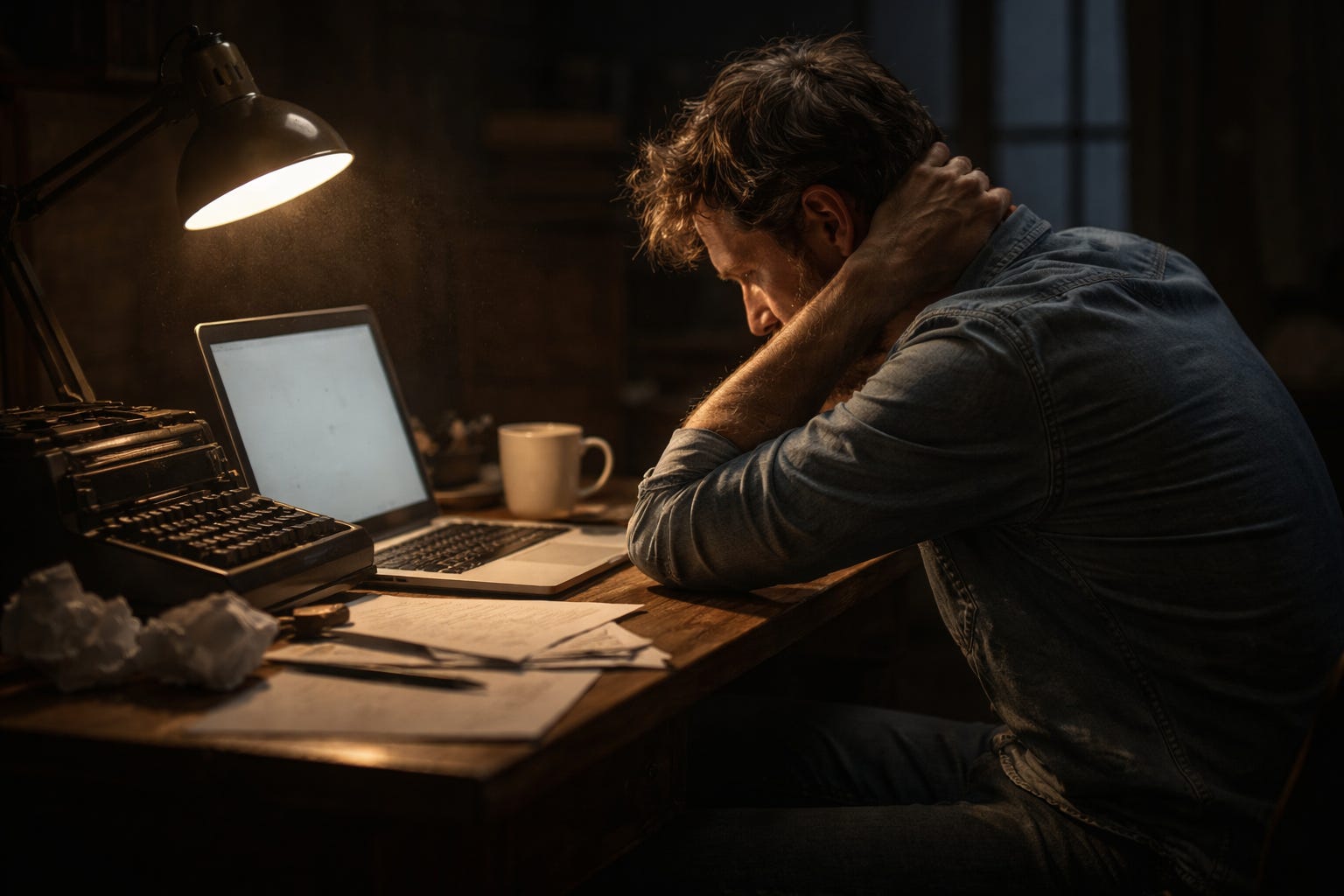
No drama. No announcement. Just a message in my inbox that landed like a brick.
“I have made the decision to give up writing and this life. I realize it’s short notice, but I wanted to give you a heads up and not pull a no-show. I appreciate your invitation and enjoyed the piece, but it seems life has different plans for me.”
Just like that.
Gone.
I wrote him back immediately. I told him the truth.
“You are a good writer. That’s not flattery. That’s truth. Your voice carries weight. It would be a loss to silence it.”
And I meant every word.
At that moment the podcast didn’t matter. The schedule didn’t matter. The show could wait. Writers matter more than appearances.
What bothered me most wasn’t the cancellation. It was the feeling behind it. The exhaustion. The quiet surrender I’ve seen creeping into people here more often than anyone wants to admit.
Because writing online can grind a person down.
When I started on Substack I had nothing. No audience. No built-in list. No magical launch. I had to bleed for every single subscriber.
Friends. Family. Old contacts. Facebook. X. Anywhere that would tolerate a link.
I asked people to read.
I asked them to share.
Most didn’t.
That’s the reality no one talks about. You hit publish and the silence answers back. No comments. No likes. Just the blinking cursor staring at you like a judge asking if you’re stupid enough to do it again tomorrow.
It messes with your head.
You begin to question everything. Your voice. Your honesty. Your ideas. Whether any of it matters at all.
There were days I quit.
And for a while, I actually did quit.
So when someone walks away from writing, I understand it more than most people do. Maybe he just needed a break. Maybe he’s gone for good. I don’t know.
But if he ever writes again, I’ll read it. Because that’s what this place is supposed to be about—seeing how another human being looks at the world.
Still, something feels off.
You can sense it if you’ve been here long enough.
Writers show up week after week. Quiet ones. Serious ones. The kind building slowly, brick by brick. Then suddenly another account appears with thousands of subscribers overnight.
No slow build. No crawl.
Just boom.
And you sit there staring at the screen thinking: how?
Then you look closer.
Two thousand subscribers. Forty likes. A handful of comments.
The math doesn’t lie.
Depth and numbers rarely move together.
But the platform rewards velocity, not depth. Sudden spikes get attention. Notes push them forward. Visibility multiplies. The snowball starts rolling.
Meanwhile the rest of us are hauling bricks uphill like stubborn fools who still believe the foundation matters.
I’m not saying importing an audience is wrong.
It’s marketing.
It’s smart, even.
But stop pretending everyone here is running the same race. Because they’re not.
And that tension eats at writers. Grinding quietly while watching others explode overnight can twist your mind in ways you didn’t expect.
Then politics shows up like mold spreading through the walls.
Every platform starts clean. Then outrage creeps in. Labels fly. Conversations turn into battlefields.
I’ve watched it happen everywhere.
Facebook rotted.
Twitter became a screaming arena.
TikTok turned outrage into entertainment.
Clout is the cheapest currency on the internet.
I studied political science. I believed debate mattered. I believed ideas could collide without turning people into enemies.
Now it’s mostly tribes yelling past each other.
That’s why I refuse to write politics here. I won’t become another voice feeding that machine. The truth is simple and ugly.
Most politicians don’t care about you.
They care about your vote.
That’s it.
Substack was supposed to be different. Slower. Human.
Writer to reader.
Then another thing arrived that made my blood boil.
Automation.
We were talking about “performance versus authenticity” on Stories, Soul Work & Substack when Nat Sang mentioned something that stopped me cold. She said some writers are now using AI to respond to comments automatically. A reader takes the time to read a piece, think about it, and leave a thoughtful message—only to receive a reply written by a machine instead of the writer.
That’s not efficiency.
That’s fraud wearing polite language.
“Thank you for sharing your thoughts.”
But you didn’t read them.
You didn’t think about them.
You didn’t care.
You automated presence.
Connection cannot be automated. Not if you want it to mean anything.
And then there’s the subscriber carousel.
Someone unsubscribes. Then a week later they’re back. Then they disappear again. After seeing it happen enough times, I finally decided to ask. I sent a few emails to people who had left. Most never replied. A few did.
Their reason?
“Inbox is full.”
That was it.
So your writing—the hours you spent thinking, writing, editing, and hitting publish—gets reduced to email clutter. For a moment you question yourself. Was it the post? Did the tone miss? Did I push too hard on something?
No.
Their inbox was crowded.
It’s a strange feeling when the value of your work is measured against someone’s unread email count. Especially when the solution is simple. You can turn off email notifications and keep mobile notifications on. You can stay subscribed without flooding your inbox.
It takes five minutes.
You can stop the flood without cutting people off.
Then there are the small irritations no one bothers to mention. The kind that seem trivial until you live with them every day. The glitches. The endless scrolling inside the Substack app. You’re halfway through replying to someone who actually read what you wrote, someone who took a minute out of their life to think about it, and suddenly the screen snaps back to the top. The comment you were answering vanishes. The thread is gone. Now you’re hunting through the feed trying to find the conversation again.
It sounds minor.
But small frictions accumulate. Enough of them and the whole machine starts to grind.
Time matters.
Attention matters.
And the internet wastes both with careless ease, spilling them like water from a cracked bucket.
Yet here we are.
Automation growing louder. Metrics replacing meaning. Growth hacks taking the place of craft.
You can chase numbers.
You can automate engagement and call it community.
Or you can do it the slow way.
Show up.
Write honestly.
Respond like a human being.
Build something brick by brick.
One path builds numbers.
The other builds spine.
I’m angry about this platform because I still believe it can be better.
I’m not here for convenience.
I’m not here to fake connection.
If it takes longer to grow, so be it.
I’d rather build something real than win something hollow.
Your Fellow Writer,
Rinaldo
Thank you for reading. This work is reader-supported, and your presence here matters.

About the Author
John Rinaldo writes Soul & Stories, a weekly publication centered on soul work, reflection, and the quiet process of becoming. He also hosts the live podcast Stories, Soul Work & Substack every Monday at 4 PM EST, where written ideas open into honest conversation.
He is currently working on The Hole: Forgotten in the Shadows, a documentary written and hosted by John Rinaldo and Hassan, telling the story of Italians who resisted and secretly helped smuggle Jews to safety during World War II.

© 2026 John V. Rinaldo. All rights reserved.
This work is protected under U.S. and international copyright law. No part of this publication may be reproduced, distributed, displayed, or transmitted in any form without prior written permission. Official publications are released only through verified accounts directly controlled by John V. Rinaldo.
Oh yes this I feel too John, and sometimes I feel its totally meaningless. Is Substack any different than other social media?! To be honest I don’t think so but I still hang in here. Why? I don’t know and I am not sure I will continue either. I love writing. The number of Subscribers is not important. The number of likes and comment plays a role, not big though. I have days and periodes with frustration. The algorithm and how some notes simular to mine go virtual and mine get like 15-25 likes?! I dont focus on it because it only harms you. Substack is not the main thing in my life anyhow. There are good people on Substack, and I also like to read and comment . I just dont allow it to completly take all my precious time.Living a good life with my love ones and a good health is number one, and will always be💟 Thank you for a very good and relevant article❣️
And now from one reader’s perspective. This reader knows that your writing is real. I know that it is thought out, maybe shelved until it feels complete while you work on something else. But you see or feel the difference in numbers where I see the difference in style. I don’t have to worry that you used ai to write your work. That’s not true with many writers who produce work nor do I have to google to prove a fact. It’s real vs paint by numbers. What you don’t see in your numbers or even replies is how often a column or daily thought is shared. Maybe I can see that numbers matter, because they do on here, but what about the things we screen shot or forward to a daughter? How do you quantify that?